
14 December 1989
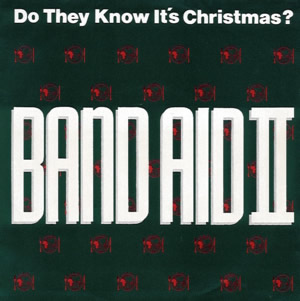
Only two singers appear on both the original 1984 Band Aid and the 1989 Band Aid II: Sara Dallin and Keren Woodward of Bananarama. Looking around the room in 1984 they would have seen hi-wattage superstars like George Michael, Boy George, Simon Le Bon, Sting and Bono. In 1989 the ambient light was a whole lot dimmer. Comparison is the thief of joy, but so is having to slum it with Matt Goss and Marti Pellow.
Whatever the reasons for convening Band Aid II—well-meaning response to another severe famine in Ethiopia, a trend for charity records, the class of ’89 wanting their turn—Stock, Aitken and Waterman were completely the wrong people for the job. ‘Do They Know It’s Christmas? has its inherent faults, but it’s also quite a strange, shape-shifting thing that requires a few massive gear changes to get from the clanging chimes of doom at the start to Bono’s Line, and then from there to the big cheery singalong ending. By contrast, SAW were barely able to make one of their own songs sound different to another, which would have been less of a problem if that single transferable song of theirs didn’t sound like a water-damaged Casio keyboard.
Surprisingly, the main failing of Band Aid II isn’t the SAW sound; it’s the pseudo-soul showboating by a wave of new singers apparently in thrall to Joe Cocker. Marti Pellow is dreadful here, but the worst offender is Lisa Stansfield with a truly bizarre vocal performance: a strange “nnnhh” grunt followed by a nasally shudder, like a vibrator cycling down some steps. Aside from all that emoting to the gallery, there are other low points of a different order. Bringing a chorus up before the second verse breaks the thread of the song, a subtlety I doubt was on SAW’s radar anyway. Matt Goss has to be helped with Bono’s Line by, of all people, Jason Donovan. Cliff is a creep.
In fairness, Band Aid II gets one over on Band Aid I in an important respect; it has lead vocalists who aren’t white males. Granted, Kylie was the biggest pop star in SAW and in Britain, so that call wasn’t purely out of feminist zeal. But the old-school soulful four-part harmony by the Pasadenas really suits that chorus: hardly revolutionary but, like Dizzee Rascal’s rap in another version, at least they bring something different. Of course, writing a new song in a new idiom for a new generation would have been a more daring and inventive thing to do. That said, given who was in charge here, maybe it was best not broached. Our walk across the rooftops of the 1980s charts ends with a reminder that a number one single is a measure of quantity, not quality.