
9 August 1996
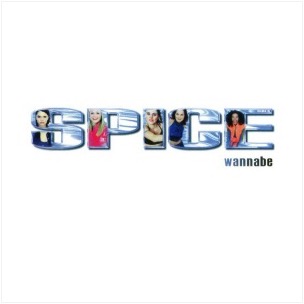
Lucy O’Brien and Caitlin Moran are among those who’ve pointed out that feminism suffered by being simplified to the Spice Girls concept of Girl Power, the latter defined by Moran as “being friends with your friends and buying Spice Girls records”. As O’Brien notes in the revised and updated edition of her book She Bop: The Definitive History Of Women In Popular Music, the phrase “girl power” was already used by Kathleen Hanna, her band Bikini Kill, and the early-’90s wave of female-led alt-rock acts. None of those were likely to have numbered Margaret Thatcher among their peers as the Spice Girls (perhaps flippantly) did.
As well as commodifying feminism as Girl Power—not entirely the doing of the group themselves—the success of ‘Wannabe’ also commodified the Spice Girls with those cartoonish and remarkably sticky nicknames (coined by Top Of The Pops Magazine) that called their only person of colour “Scary” and cast another adult woman as “Baby”. There’s patriarchal capitalism for you! For all the cultural significance attached to them, the Spice Girls were put among us to sell pop records and merchandise to young teens, just like Boyzone. No harm in that, and they were undeniably great pop stars whose in-your-face attitude was an example of female self-confidence for their young fanbase at a time when the tediously laddish ’90s pop-cultural ecosystem was about to tip over into the even more toxic manosphere ’00s.
Aside from its status as Girl Power manifesto, there’s enough to commend ‘Wannabe’ as a pop single. “If you want my future, forget my past” is a smart, confident opening verse line which surely chimed with many women. The rest of the song has plenty of memorable vocal hooks, “zigazig-ah” and all. And you can’t deny its irrepressible energy and charm, even if the rap by Geri and Mel B puts demands on your indulgence. From here on in the Spice Girls singles are a sequence of diminishing returns. ‘Wannabe’, though, is better than every Boyzone single put together, though I appreciate this is as reductive as decanting the entirety of feminist representation, agitation and thought into a mainstream commercial pop act saying “Girl Power”.

