
22 April 1967
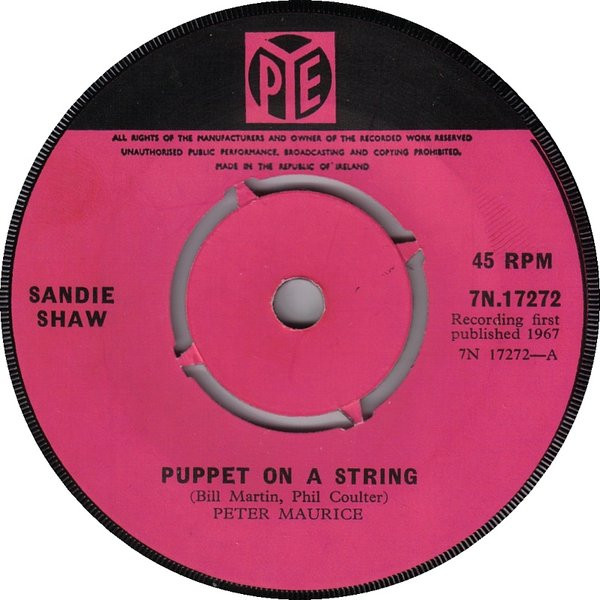
Here’s the first Eurovision winner in English, the first Eurovision winner for the perfidious Royaume-Uni, and the first Eurovision winner to top the Irish charts. In claiming this factoid triple crown for the UK, ‘Puppet On A String’ pipped that year’s Irish entry, Sean Dunphy’s bucolic ballad ‘If I Could Choose’, which finished second on the night and second in the charts – the first Irish Eurovision entry not to go to number one in Ireland. However, this UK edifice was built by imported Irish labour, as ‘Puppet On A String’ was co-written by Phil Coulter. We’ll get to savour this Ireland vs The Brits sub-plot in many more Eurovisions to come.
‘Puppet On A String’ had precedent in the bouncy pop and tired sexism of the Eurovision winner two years previously, France Gall’s ‘Poupée De Cire, Poupée De Son’ (literally “wax doll, rag doll” with the second part also a pun on “sound doll” i.e. the young female singer) for Luxembourg. That song’s writer, a monsieur S. Gainsbourg of Paris, France, also had a song in the 1967 Eurovision, the equally frivolous ‘Boum-Badaboum’ for Monaco which finished fifth. So, our own Phil Coulter, with co-writer Bill Martin, pips Serge for the honour of creating the template for what Eurovision lovers and haters alike will recognise as that divisive strand of frothy, gimmicky Eurovision entry. (By contrast, Gainsbourg goes on to create his 1968-71 masterpiece era of ‘Bonnie And Clyde’, ‘Initials B.B.’ and the Histoire de Melody Nelson album.) The UK would do the dog on it with Coulter and Martin’s 1968 follow-up ‘Congratulations’ for Cliff, then Lulu’s ‘Boom-Bang-A-Bang‘ (an English ‘Boum-Badaboum’, if you like) in 1969 and Clodagh Rodgers’ ‘Jack In The Box’ in 1971 in Dublin, but other countries followed too with their ‘Ding-A-Dong’, ‘Diggi-Loo Diggi-Ley’ and what have you. Finishing fourth in Eurovision 1967, by the way, was a song for Luxembourg called ‘L’Amour Est Bleu’ which as instrumental piece ‘Love Is Blue’ for easy-listening bandleader Paul Mauriat would become the first US number one single for a French act, and which on the night was sung by future Eurovision-winning singer Vicky Leandros. That’s the far-reaching Eurovision 1967.
As for ‘Puppet On A String’ away from its Eurovision context, the fresh pop energy of Sandie Shaw—who apparently hated the song from day one—glosses over the sexist title simile to sell it as a tale of giddy, dizzying romance. The fairground organ, toy-town percussion and farting tuba are queasily naff, but Shaw’s playful clipped delivery in the chorus (“one day THAT! You say THAT!”) gives some much-needed character. Swings and roundabouts, then.