
22 January 1972
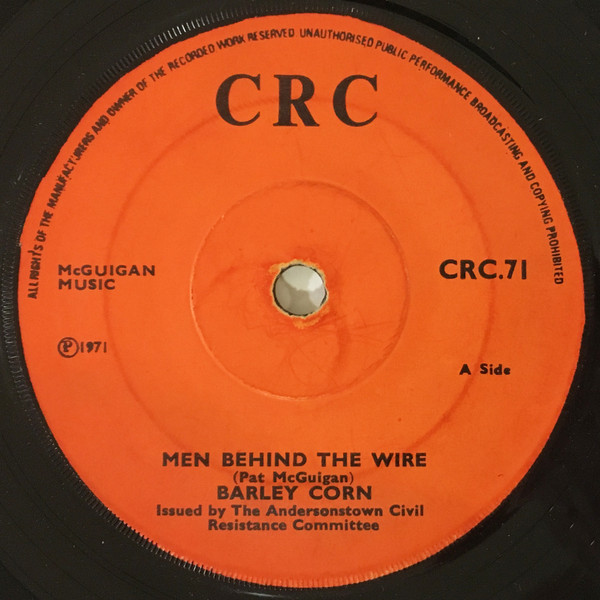
This chart-topping original of ‘The Men Behind The Wire’ has a spoken-word introduction:
On Monday the ninth of August 1971 at 4:30 a.m., Irish men from all over the six counties were taken from their homes. Hundreds of these men are now imprisoned without trial. This song is borne of the civil resistance campaign which has followed internment – a song dedicated to those men in Long Kesh concentration camp: the men behind the wire.
Until now, Ireland’s chart-topping nationalist songs were escapist historical action yarns about fighting the Black and Tans, who by 1972 were fifty years gone. ‘The Men Behind The Wire’, though, is a contemporary song about contemporary events – and what’s more, contemporary events in Northern Ireland, the Republic’s elephant in the room, our first Mrs Rochester in the attic at the top of the island. The song is a protest against internment—the round-up, imprisonment and brutal treatment of hundreds of presumed IRA members without evidence, charge or trial—and during its second week at number one in Ireland an anti-internment march took place in Derry; British paratroopers shot and killed thirteen unarmed civilians at that march on 30 January 1972, Bloody Sunday.
So, does ‘The Men Behind The Wire’ topping the Irish charts mean that 26-county Ireland was ditching the Saturday night Fenian routine and engaging with real-world issues in the northern six? Perhaps the immediate driver was that it’s an undeniably stirring folk ballad. The viscerally memorable “Armoured cars and tanks and guns / Came to take away our sons” must be one of the greatest opening couplets of any Irish song ever, the chorus has a rousing call to action, and all throughout the lyrics are evocative and direct without resorting to the barstool bravado and sentimentality of lesser ditties. Interestingly, the song also seems to appeal to English public opinion about the actions of its soldiers: “England’s name again is sullied / In the eyes of honest men”. And the lyrics call for listeners to “march behind our banners”: not violence, but civil resistance and protest such as in Derry on Bloody Sunday.
However, maybe the official and mainstream mood hadn’t changed all that much. RTÉ had apparently banned ‘The Men Behind The Wire’ since early January 1972, presumably from squeamishness about the subject matter and a fear of perceived IRA sympathy rather than anything explicitly said in the lyrics. (The first time I ever heard ‘The Men Behind The Wire’ on TV or radio was when Steve Coogan’s Martin Brennan sang it on prime-time BBC in 2019.) Yes, we’ll soon also have in 1972 two number one singles in response to Bloody Sunday, and also banned by RTÉ — but a mere twelve weeks after Bloody Sunday there’ll be a chart-topping single in Ireland from a British Army regiment stationed in Northern Ireland.