
29 April 1972
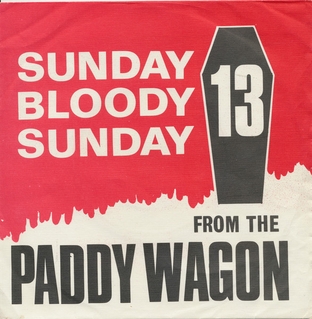
So the British Army’s chart-topping reign in Ireland only lasted a week. Be it buyer’s remorse or a new-found sense of awareness and taste, they were dislodged by an Irish folk protest song about the killings on Bloody Sunday. Despite merely recounting the obvious events and not calling for listeners to reprise with violence or join their local flying column, the song was, if not banned, then euphemistically “not played” by RTÉ, probably from a sentiment of the Irish government not wanting to rub up the British government the wrong way.
Paddy Wagon were a folk showband of mostly Donegal origin. Bass player and vocalist Patsy Fayne here becomes the 11th Irish woman to have a number one single in Ireland in the first ten years of the Irish charts; it’ll take a further twenty years for us to see the next eleven. Their band name, pointedly apposite at the time for a record protesting British justice, today feels more whimsical for being shared with a well-known stage-Irish bus tour operator.
As for the song whose title is shared with that by another well-known Irish outfit beloved by tourists but eye-rolled by natives, ‘Sunday Bloody Sunday’ is similar to ‘The Men Behind The Wire’ as an up-tempo folk ballad with a martial beat and slightly sing-song rhythm. While it doesn’t pack the visceral punch of that other number, it follows the same lyrical first principle of sticking to factual language rather than theatrical flourishes, and is all the stronger for it. Were its references to how “the paratroops were waiting / And coldly gunned them down” with “British lead”, formulations no doubt heard in countless news reports and political debates of the time, seriously justification for a de facto ban by the national broadcaster just because they were made instead on a folk record at the top of the pop charts? Were paramilitary recruiters inundated with eager new volunteers whose eyes and minds were finally opened by a Donegal showband? And for the sake of balance did RTÉ also ban “not play” the contemporaneous chart-topping record three months after Bloody Sunday by the musical wing of—and I can’t emphasise the weirdness of this enough—a British Army regiment actually stationed in Northern Ireland?
Anyway, this non-Bono ‘Sunday Bloody Sunday’ brings an end to the febrile political content at the top of the 1972 Irish charts. For the rest of that year we’ll see glam, bubblegum, two new Irish superstars… and an Irish showband. How long must we sing this song?