
5 October 1972
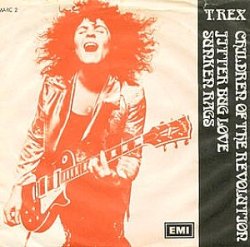
The crop is getting noticeably thinner; ‘Children Of The Revolution’ doesn’t have a bridge or a third verse, and at barely two-and-a-half minutes it’s half the length of ‘Hot Love’ and two minutes shorter than ‘Get It On’. Also thinning off here is the market demand; ‘Children Of The Revolution’ didn’t get to number one in the UK and neither will any future T. Rex single. They still have two huge classics to come, one of which gets a ’90s afterlife thanks to the denim-clad marketing muscle of Big Trousers, but in 1973 Slade and the Chinn & Chapman wave of glam ordinaire will take over the charts; later that year T. Rex singles will even stop cracking the UK top ten. On the other flank, Bowie and Roxy will take glam premier cru into a hipper and artier realm before kicking on to create the template for ’80s pop, the glam rock ship long left behind with Marc Bolan tied to the mast.
(Digression. The IRMA database at irishcharts.ie lists the subsequent ’20th Century Boy’ as having reached number one in Ireland. However, charts reproduced from that time, such as on the valuable UKMIX chart discussion forum, show it as only getting to number eleven. That lower placing, alas, sounds more plausible. Could the latter-day and generally fine IRMA database compilers have rendered 11 as 1 by a typo? Now read on.)
The portion here may be smaller but you can’t knock the quality of the fare. The heavier riff shows Bolan was trying to shake up his sound – okay, so the avant-garde of Bowie and Roxy wasn’t within his compass, but he’s at least seeing the popular rock stomp of Slade and raising it. Also, as well as being darker, more real-world and more ominous than the playful lyric hooks of his previous hits, the chorus of ‘Children Of The Revolution’ may well be the best one Bolan ever wrote. It’s triumphant, unforgettable and glorious. All week I’ve been singing it to myself in private. Maybe I should start singing it at other people in public.
So, notwithstanding the uncertainties of Ireland’s 70s chart data as noted above, or the resuscitative powers of today’s social media trends and prestige TV soundtracks, this is our last encounter with T. Rex and the greatest pop star who ever lived. The image of Marc Bolan going down with the glam rock ship is true to an extent; he was its innovator and figurehead, its poster-boy and avatar. And yet ‘Children Of The Revolution’ suggests he wasn’t necessarily fated to be trapped in the amber of the glam era. The following year’s ‘Solid Gold Easy Action’ and especially ’20th Century Boy’, which replace the banshee wail of Flo and Eddie with the pop power of Sue and Sunny as backing vocalists, see Bolan rejuvenating his sound with influences from US soul. Later singles don’t have the same memorable songs or catchy choruses but do have Bolan integrating disco and blues-rock to intriguing effect. In particular, the wonderful Stones-y 1976 single ‘Laser Love’ is as slinky and swaggering as prime ’71 T. Rex while still mercurial and forward-facing; whatever about the ravages of punk, it showed a Marc Bolan who would have been more than capable of thriving in post-punk and new wave. And anyway, what was punk but glam’s kid brother? However, ‘Laser Love’ didn’t even get into the UK top forty. Within a year, and still only twenty-nine, Bolan was dead.
Back in late 1972, with its first superstar and innovator heading for the Smash Hits “dumper”, where to next for ’70s chart pop? Happily, glam will still have a formative hand in the next great pop act of the decade—one that will match T. Rex and even The Beatles in terms of chart success, creative achievement, iconic visual identity and enduring adoration. But that’s another chart-year-and-a-half away. Before that, there’s a whole lot of cheaper glam, tackier bubblegum and schmaltzier schmaltz to battle through, and it’ll be a near-run thing.