
29 March 1973
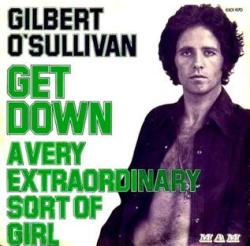
Okay, ‘Get Down’ is not really about a dog. That would merely be a dad joke. Instead, this is a whole Dad Stand-Up Comedy Special, baby! So, we have a song called ‘Get Down’ that sounds funky so you think it’s about getting down on the dancefloor, but then it starts off seemingly telling a dog to get down, like ‘Martha My Dear’ by Gilbert’s antecedent in bubblegum schmaltz, but in fact he’s telling a human person to stop pawing him, so he’s comparing the person to a bad dog, while he himself feels like a cat—on a hot tin roof!—and… Excuse me for a moment while I stick my head out the window in the hope that a flower pot falls from upstairs, or an anvil. I’m prepared to wait.
As with ‘Ooh-Wakka-Doo-Wakka-Day’ and ‘Clair’, ‘Get Down’ is in one sense yet another portfolio of Gilbert’s stellar gifts. The funkiness is plausibly funky in a way no Irish person has ever been before or since. The tune is a rollicking piano bop. The chorus sticks like velcro. Right at the end Gilbert throws in a brief side-quest key change before settling back into a catchy outro groove. All this is good.
And yet, also as with those two previous chart-toppers, ‘Get Down’ is a showreel of Gilbert’s commitment to knuckle-gnawing naffness. I’ve detailed the sense of humour above. The weak rhymes feel tossed off: “You give me the creeps / When you jump on your feet” is particularly this’ll-do. In the spirit of the whole thing, call it doggerel. The reference to Cat On A Hot Tin Roof is cheesy light-entertainment smart-aleckry. And the cover image (above) of Gilbert as torso-baring ride-fodder is a move that was surely left hanging. When I say this is the best of Gilbert’s three Irish number one singles, I simply mean it is less egregious than the other two, slightly. But I’m still singing it to myself, and happily so. Once again, a Gilbert hit leaves me conflicted.
That’s the end of our chart-top encounters with Gilbert O’Sullivan. It’s a pity we’ve come to him a bit late; first-wave Gilbert of ‘Nothing Rhymed’, ‘We Will’, ‘Matrimony’ and ‘Alone Again (Naturally)’ may have been maudlin or twee but could balance that out with intriguing flashes of bleakness, joy, empathy, insight and pain. Those records still have a lot to offer. Second-wave Gilbert of his three Irish number one singles, however, puts his talent for catchy tunes to the service of unfettered whimsy, and that plus his early Bisto-Kid look made his obsolescence inevitable. After ‘Get Down’ he continues to have top ten hits in Ireland for a couple of years, but his story since then is mostly his fall from fashion and two landmark court cases in which first he won back a fortune in royalties from his manager—Clair’s dad—and then transformed hip hop by bringing about the legal requirement for prior clearance of samples.
Other Irish artists have tried to draw our attention back to Gilbert’s pop achievements; Christy Dignam used to do a fine version of ‘Nothing Rhymed’ that mined the despair and cast the whimsy as slight desperation, while CMAT made her American TV debut performance dressed in Gilbert-core brown knitted tank top as a nod to him being the first Irish act to have a US number one. However, the wider Gilbert revival is yet to happen. There are reasons: ‘Clair’ lands differently today, ‘Alone Again (Naturally)’ may be too bleak and triggering for daytime radio, and no tastemaker’s going to take seriously the pudding-bowl-haircut phase or something called ‘Ooh-Wakka-Doo-Wakka-Day’. He may be permanently branded with the mark of schmaltz, and perhaps justifiably so, but Gilbert O’Sullivan is still Ireland’s greatest ever pop songwriter. It’d be a shame if we couldn’t find some path to appreciating that legacy.

Discover more from Irish Number Ones
Subscribe to get the latest posts sent to your email.

