
25 April 1974
The unluckiest pop song in history is ‘Si’ by Italian singer Gigliola Cinquetti. An impressive blend of hushed early-’70s bedsit folk-pop and sweeping orchestral balladry, it was selected as Italy’s entry for the 1974 Eurovision. That’s when its problems began.
Eurovision 1974 happened to coincide with campaigning in Italy for a yes-no referendum on divorce. Since it shared its title with one of the ballot options, ‘Si’ was effectively censored by Italian radio and TV for the duration of the referendum campaign. State broadcaster RAI even deferred showing that year’s Eurovision until early June, after the referendum. As a result, the song wasn’t a hit in Italy.
Okay, so there was trouble at home. ‘Si’ was still Italy’s Eurovision entry, though, and come competition time in Brighton that April things were looking good. After all, Cinquetti had already won Eurovision for Italy ten years earlier, while only 16, with a song whose title translated into English as ‘I’m Not Old Enough’. During the postcard sequence before she took to the stage, BBC TV commentator David Vine called ‘Si’ “the most beautiful song in the competition”. With experience and racing form, plus a strong song, Cinquetti seemed a good bet to become the first singer to win Eurovision twice. Her rivals on the night included future Grease superstar Olivia Newton-John for the UK, imminent UK and Irish chart-toppers Mouth & McNeal for the Netherlands, a song from Portugal that was later used as a coded signal to start the revolution that toppled the Salazar fascist dictatorship, and an unknown four-piece group from Sweden.
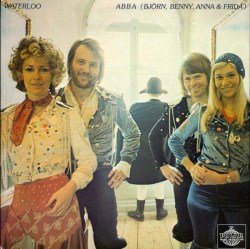
Gigliola Cinquetti with ‘Si’ finished second; it took a generational Eurovision entry—a generational pop record—to beat her.
Eurovision has been dining out on ABBA and ‘Waterloo’ ever since. Could ‘Waterloo’ have conquered the world without Eurovision, though? It’s possible. Dutch rock bands like Shocking Blue and Golden Earring had hits in English-speaking countries in the preceding years, so why not a photogenic Swedish pop act that sounded like prevailing glam hitmakers Wizzard? Did we really need Eurovision to enable a band that we know now were capable of making ‘Dancing Queen’, ‘S.O.S.’, ‘Knowing Me Knowing You’, ‘Take A Chance On Me’ and ‘One Of Us’?
Also, ‘Waterloo’ could never have remained a local or regional hidden gem. You already know how it’s patently magnificent, from the imaginative lyrical conceit to that sumptuous second chord in the verse to the iconic choreography (okay, it’s just standing and turning at right angles while dressed as ABBA, but still) to the memorable chorus. I’ll highlight the bridge out of the first chorus, where Agnetha and Frida’s voices combine on the same long “Aaaahhh!” into the piledriving piano chords of the second verse to create a thunderous rapture. It’s one of the most thrilling moments in all of pop. ‘Waterloo’ is so brilliant that I’m convinced the naff saxophone in the chorus was put in there deliberately to pull the song back from being literally perfect and thereby causing some sort of rupture in the time-space continuum. It would have been a hell of a way for the world to end. Instead, we’ll get further opportunities to savour ABBA at the top of our charts.
Gigliola Cinquetti never did win a second Eurovision. However, she went on to host Eurovision in 1991 after it was won again for Italy by Toto Cutugno, previously of ’80s hit ‘I Eat Cannibals’ and her co-host on the night. (I seem to remember his black hair dye running down the side of his face, Rudy Giuliani style, by the end of the voting.) Coincidentally, that year’s Eurovision also produced a wonderful runner-up: Amina for France with the dreamy west and north African vibes of ‘C’est Le Dernier Qui A Parlé Qui A Raison’. Amina and France were only beaten on a tie-break, with the winner being a far weaker song from… Sweden. The history book on the shelf is always repeating itself.

Discover more from Irish Number Ones
Subscribe to get the latest posts sent to your email.

