
18 July 1974
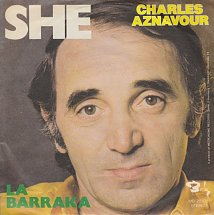
I once stood behind Charles Aznavour in a queue at the bank in Paris. He was courteous to the teller and got his business done quickly. That, I’m sorry to say, is my best celebrity encounter story from the eight-and-a-half-years I spent Seine-side. You’ve probably had starrier celeb sightings or meetings in Dublin and certainly in West Cork.
This underwhelming Paris anecdote also means that Charles Aznavour is the only Irish number one act I’ve ever encountered in real life. Call me aloof, but I find this sort of emotional distance essential for the clear-eyed intellectual rigour I bring to analysing Ireland’s historically bad music purchases. Also, I’d be concerned if Chris de Burgh knew where I live. Anyway, I’ll be professional and not let that profound personal connection to Aznavour affect my critical faculties in contemplating ‘She’.
I suppose now is a good moment for me to question my assumption that you know who Charles Aznavour is. In Britain and Ireland he might just be known for ‘She’ and at a stretch ‘For Me Formidable’, but in France he was a figurehead of the chanson française sound, plus during the ’70s he was a genuine global star. He appeared on The Muppet Show, and Liza Minnelli credits him for the stage singing style she developed ahead of her Oscar-winning turn in Cabaret. Armenia, homeland of his parents, made him their ambassador to Switzerland. His voice has a touch of Piaf’s trembling emotion and Brel’s sombre bravado, but otherwise Aznavour was an avuncular and twinkly-eyed icon of the popular global image of French culture and Paris life: nostalgic cabaret ballads about days past and loves lost, like a singing cartoon accordion wearing a beret and a handlebar moustache. Even though I’m not a fan of chanson française I like Aznavour’s voice and style, and in general his songs are a pleasant listening experience.
‘She’, though, is where I draw the line. It’s bad: cabaret balladry in the slushy Engelbert Humperdinck sense, with Aznavour’s tremulously animated voice boiled down to an almost comical gloop. (Engelbert has indeed covered the song, dragging Aznavour back to the scene of the crime to make it a duet.) Its lyrics are by the co-writer of Les Misérables, hence the sickly melodrama. Surprisingly, ‘She’ had been commissioned as the theme for a British TV anthology of plays about modern women, including one written by Shelagh Delaney; the song’s schmaltzy, condescending worldview of women must have seemed ill-fitting for the purpose and perhaps out of date even in 1974.
As for Aznavour, as writer of the music for ‘She’ he at least provides a stirring melody, plus he’s out of his comfort zone with such English-language doggerel. So, I’ll cut the great man a break here and tactfully recommend you listen to non-‘She’ Aznavour instead. Such are the perks of an encounter with the writer of Irish Number Ones so long as you move on quickly in the queue at the bank.

Discover more from Irish Number Ones
Subscribe to get the latest posts sent to your email.

